
Is your team or program really “trauma-informed”?

Every program claims to be “trauma-informed” nowadays. But has your organization really incorporated SAMHSA’s six trauma-informed principles into its services, its supervision/leadership, its policies, and the layout of the physical facility? We can help teach your clinicians, leadership, and non-clinical frontline staff how trauma impacts the body and the mind. We can help your employees recognize the difference between a trauma response and a defiant or resistant response from a client.
If you are serving humans, you are serving trauma survivors.
Trauma-informed care was developed with an emphasis not only on how treatment is provided, but also on organizational development and the structure of our agency. SAMHSA created trauma-informed care after realizing that many programs were unintentionally causing harm to clients and staff. Trauma-informed care provides a framework for providing services, but also for leadership, supervision, employee engagement, and policy development.

If you are employing humans, you are employing trauma survivors.
Dr. Scott and our team have provided trauma-informed care workshops throughout the world in treatment settings, medical systems, universities and training institutes, legal contexts, activist groups, religious/spiritual communities, non-profit agencies, governmental organizations, and corporations. We would be honored to partner with you and your team to further integrate trauma-informed care into your organization.
Trauma-informed care is evolving from a specialty into an expected and required norm in many fields. Many grants, funders, and licensing boards are requiring organizations to implement trauma-informed care into their programs to retain their funding or licensing.
Fantastic
Interact
Welcoming

Do You Offer Safe and Effective “Trauma-Focused” Services to Treat Trauma, PTSD, and Complex PTSD?

Programs that attempt to offer trauma therapy or other trauma-focused services without first creating an organizational culture of trauma-informed care are prone to unintentionally cause harm or retraumatize clients and/or staff members.
Trauma competencies are particularly important considering that the overwhelming majority of clients in treatment for mental health or addiction have a history of trauma. Many addiction experts are coming to the conclusion that addiction and relapse are largely fueled by past trauma, loss, neglect, abandonment, and adversity.
PTSD is one of the most common co-occurring disorders for folks with substance use disorders so all addiction treatment programs should have a trauma treatment component. PTSD is often overlooked as a diagnosis as it has considerable overlap with other conditions such as depression, anxiety, ADHD, substance use disorders, personality disorders, and other mood disorders.
Dr. Scott Giacomucci is recognized as a Fellow of the American Academy of Experts in Traumatic Stress (FAAETS) and can help your team increase their skills in assessing and treating trauma and PTSD while also cultivating larger organizational change in implementing trauma-informed care principles.
Dr. Scott has provided training to thousands of professionals around the world including various programs in the Philadelphia area such as:
- Mirmont Treatment Center
- Mainline Health Systems
- Caron Treatment Center
- Pinelands Recovery Center
- Banyan Treatment Center
- Maryland Addiction Recovery Center
- Chester County Department of Human Services
- Women Organized Against Rape
- Spilove Psychotherapy
- Espenshade Counseling
- Manor of Hope
- Bryn Mawr College
- University of Pennsylvania
- Philadelphia College of Osteopathic Medicine
- West Chester University
- Denver University
- New Mexico State University
- Columbia University
- Neumann University
- Antioch University
- Widener University
- Penn State University
- International Universities
- Introduction to Sociometry, Psychodrama, and Experiential Trauma Therapy
- PTSD, CPTSD, Trauma-Informed Principles, and Post-Traumatic Growth
- The Intersection of Addiction and Trauma
- Experiential Group Treatment: Sociometry and Safety Structures
- An Experiential Trauma Therapy Clinical Map: Neurobiology and Safety
- Using Experiential Work to Transform Burnout, Compassion Fatigue, & Vicarious Trauma
- Working Experientially with Defenses in Addiction & Trauma Work
- Relational Trauma Repair: Psychosocial Metrics & Psychodrama-like Interventions
- Experiential Therapy Supervised Practice
- Psychodrama and Empty Chair Work in Individual Sessions
- Society & Spirituality in Trauma and Addiction Work
- Strengths-based Experiential Work and the Empty Chair
- Role Theory, Doubling, and Attachment Theory
- Experiential Work with Loss, Ambiguous Loss, Traumatic Loss, and Resilience
- Group Work, Group Therapy, Mutual Aid, and the 12-steps
- Grief and Loss: Impacts on Clients and Staff
- The Aging Brain: When Dementia and Mental Health Overlap
- Introduction to Expressive Arts Therapies
- Healers’ Haven: Addressing Vicarious Trauma and Burnout
- Bringing IFS into Practice
- Introduction to Expressive Arts Therapies
- Supporting Survivors of Religious and Spiritual Harm
- Trauma-Informed Practices for Working with Immigrant and Refugee Communities
- Other topics available upon request
The Phoenix Center is a pre-approved provider of CE Hours for National Board of Certified Counselors (NBCC), American Psychological Association (APA), and the Pennsylvania boards of Social Work, Marriage & Family Therapy, Professional Counseling, and Psychology. Any in-services trainings by Phoenix Center staff can provide these CEs plus training hours towards certifications in experiential therapy and psychodrama.
Our fee for organizational consultation or clinical training varies based on the nature of the organization, travel distance, number of participants, type of training, and workshop content. Workshops are individualized to meet your organizational needs/preferences and include the provision of CE hours and certificates. See fee schedule below:
- Small group workshops (under 35 people)
- $550/hr or $2750/day
- Large group workshops (35-75 people)
- $1000/hr or $4800/day
- Keynote presentations (and/or groups over 75 people)
- $2000/hr
*Reduced cost offerings are provided to non-profit organizations and international communities on a limited basis. Write to us if cost is the only thing holding you back from working together!
The Facilitator
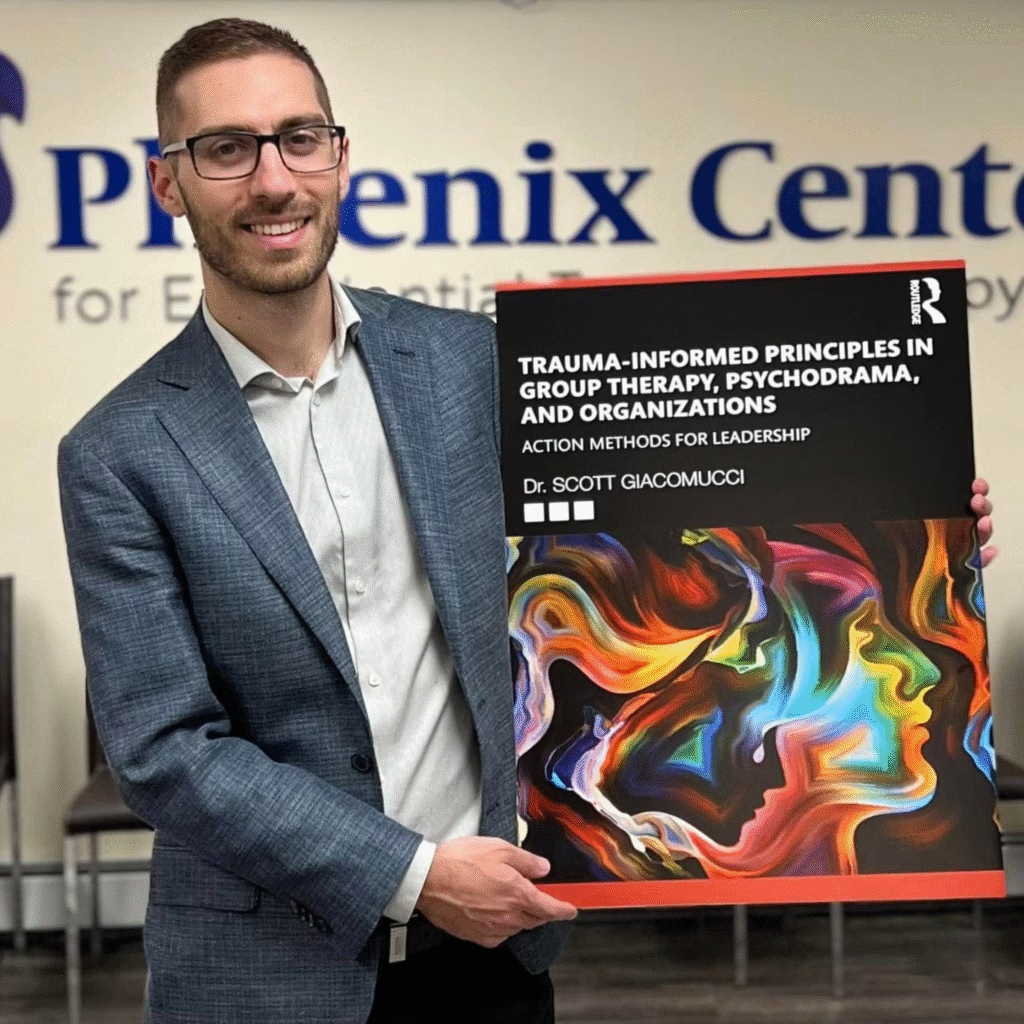
Dr. Scott Giacomucci’s work has been internationally recognized, and he is the recipient of various awards. He has published various articles on using experiential methods (especially sociometry, psychodrama, and group work) in clinical, educational, community, and organizational settings. Scott has taught trauma-focused psychodrama courses as an adjunct professor and research associate at Bryn Mawr College Graduate School of Social Work & Social Research, University of Pennsylvania’s Doctorate in Clinical Social Work Program, as well as Villanova University’s graduate counseling program.
Throughout his career, he has published several books that have been used in many graduate courses internationally. He is Co-Chief-Editor of the Journal of Psychodrama, Sociometry, and Group Psychotherapy. He is an active member of the International Association of Group Psychotherapy & Group Processes (IAGP) Social and Collective Trauma Committee and Psychodrama Division.